COLOUR-CODED .
TRACKABLE .
FOLDS FLAT FOR THE RETURN LEG .
Steel transport cages for courier networks, freight companies and parcel depots. Colour-code dangerous goods and priority freight so handlers see the category before they read the label. Add NFC or RFID tracking so every cage is visible across the network. And when the run is done, empties fold flat and backload four-to-one. Designed, tested and shipped across Australia & New Zealand.
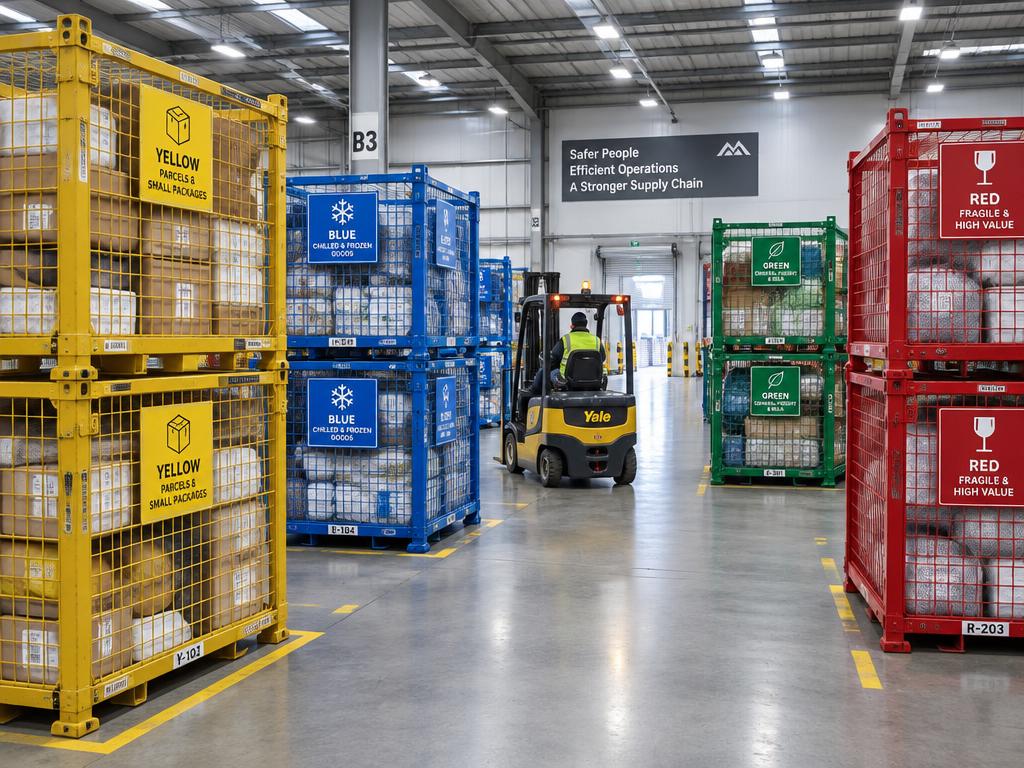
Built for the way a depot actually runs
Parcel & freight sorting
Mesh cages that move through the depot as one unit — forklifted from truck to sortation to staging without a parcel touched twice. Colour-coded by run, zone or destination.
Dangerous goods
Colour-coded cages keep DG consignments separated from general freight at every touch point — visible from across the floor, not just on the label.
Priority & express freight
A different colour marks the priority lane. Handlers see what is urgent before they read the connote, so express freight never sits in the wrong pile.
Returns & backloading
Empty cages fold flat and stack on the return leg, so a truck brings back roughly four times the cages it delivered. That is the cost that kills competitors' rigid crates.
Linehaul & cross-docking
Interlocking cages stack two to three high in a semi or container and arrive locked together — no shifting in transit, no strapping each unit individually.
Last-mile staging
Load a cage per run at the depot and fork it straight onto the delivery vehicle. The driver picks from an organised frame, not a pile of loose cartons.
Two-high truck loading
Cages stack two high inside a truck, so loose freight rides in a steel frame instead of piled loose — doubling the load per truck and turning dead air above the floor into usable, space-efficient capacity.
See the category before you read the label
On a moving depot floor, a label is the second thing a handler sees. Colour is the first. Pair colour-coding with electronic tracking and every cage is identifiable by eye and traceable by system — from dispatch to delivery to backload.
Colour-coded by category
Painted in any RAL colour so handlers identify dangerous goods, priority freight, temperature-controlled or returns at a glance — no label reading required on a moving floor.
NFC or RFID tracking
Optional NFC tags or RFID chips fitted to every cage. Scan in at dispatch, scan out at delivery, and know exactly where every cage is across the network in real time.
QR & barcode plates
Laser-cut or engraved ID plates with QR or barcode for scanning into any existing WMS, TMS or yard management system — no proprietary software lock-in.
Asset numbering
Each cage stamped with a permanent asset number so lost or misrouted cages are traced back to a run, a depot or a fleet without ambiguity.
The return leg is where the money is
Rigid crates and stillages ride back empty at full volume — you are paying to move air. Foldable transport cages collapse flat and stack four-to-one on the return leg, so the same truck brings back the cages for the next run at a fraction of the space.
Four-to-one backload
Empties fold flat and stack four to one, so a returning truck carries four times the cages it delivered — not four times the air.
Colour-coded categories
Dangerous goods, priority freight, returns and temperature-controlled consignments each get a colour. Handlers sort by eye before they touch a label.
Trackable end to end
NFC, RFID, QR or barcode on every cage, scanned into your existing system. No black boxes, no proprietary software, no lock-in.
No shrink wrap
Freight rides in a steel frame, not wrapped in film. Nothing to cut, nothing to dispose of, no single-use plastic in the waste stream.
Stack in transit
Loaded cages interlock and stack two to three high in a trailer or container. They arrive locked together — no shifting, no individual strapping.
Built for the floor
Welded steel, four-way forklift entry, load tested before dispatch. Made for daily rough handling across multiple depots and runs.
Three footprints that fit the network
| Size | Footprint | Safe load | Typical use |
|---|---|---|---|
| Standard | 1,200 × 1,000 mm | 1,000 kg | Parcel sortation, general freight, express staging |
| Large | 1,200 × 1,200 mm | 1,500 kg | Heavy freight, linehaul consolidation, cross-docking |
| Half | 800 × 600 mm | 500 kg | Last-mile runs, small parcel staging, returns |
Transport cage questions we get asked
Send your network details — depot dimensions, vehicle types, the categories you need colour-coded and any tracking system you already run. We size the cage around your operation.
How do transport cages save money on backloading?
Empty cages fold flat in seconds and stack four-to-one, so a truck returning from a delivery run brings back roughly four times the cages it delivered. Rigid crates or stillages that do not fold ride back empty at full volume — that is the hidden cost that foldable cages remove from every return leg.
Can the cages be colour-coded for dangerous goods and priority freight?
Yes. Every cage is painted in a hard-wearing RAL powder coat, and the colour is your choice. Run dangerous goods in red, priority freight in yellow, returns in blue — whatever your network uses. Handlers see the category from across the floor before they read a single label, which reduces mis-sorts and missed-connection costs.
What tracking options are available?
Optional NFC tags or RFID chips can be fitted to every cage, scan-readable at dispatch and delivery. Laser-cut or engraved QR and barcode plates integrate with any existing warehouse, transport or yard management system — there is no proprietary software to buy. Each cage also carries a permanent stamped asset number.
Do the cages fit standard trailers and containers?
The standard 1,200 × 1,000 mm footprint is designed to pair across a trailer floor and stack two to three high inside a semi or shipping container. Loaded cages interlock so they do not shift in transit and do not need individual strapping.
Are they strong enough for a high-turnover depot?
Yes. Welded steel frames, forklift entry on all four sides, and every unit load tested and stamped before dispatch. They are built for daily rough handling across multiple runs and depots, not tidy warehouse work.
Can we spec a cage to our existing equipment?
Yes. Send your sortation, conveyor or vehicle dimensions and we will size the footprint, stacking height and fork pocket spacing to fit. Volume runs can be branded, numbered and colour-coded to your network's standards.
What finish do they come in?
Painted in a hard-wearing RAL powder coat as standard — and the colour is specified by you for category coding. A heavier-duty coating is available for yards and exposed storage.
How do we order for a fleet or depot rollout?
Pricing is by quote. Send your quantities, the categories you need colour-coded, and any tracking requirements. We quote within one working day and can plan a staged rollout across depots.
Running a depot or yard? Compare stillages against fixed pallet racking, or see the collapsible pallet cage range.
Get transport cages priced for your network
Send your quantities, colour categories and tracking needs — we quote within one working day.